
The Glycemic Index, Explained Simply (With the Numbers)
 Image generated with AI — may not represent the actual product.
In short
The glycemic index gets quoted everywhere and understood almost nowhere. It is a genuinely useful idea with a genuinely important limitation, and both are simple once laid out.
The Olaben Kitchen shares recipes and food inspiration only. This is not medical or nutritional advice. If you have a health condition, allergies or specific dietary needs, please consult a qualified professional.
The glycemic index gets quoted everywhere and understood almost nowhere. It is a genuinely useful idea with a genuinely important limitation, and both are simple once laid out. Here is the whole thing without the jargon.
What the glycemic index is
The glycemic index, or GI, ranks carbohydrate foods by how fast and how much they raise your blood sugar, on a scale of 0 to 100. A high-GI food sends blood sugar up quickly; a low-GI food raises it slowly and gently.
The cutoffs, from the international reference tables published in the American Journal of Clinical Nutrition:
|
Band |
GI value |
|
Low |
55 or under |
|
Medium |
56 to 69 |
|
High |
70 or above |
Why care? A fast spike is usually followed by a fast drop, which brings hunger and the afternoon energy dip. A slow, low-GI release keeps energy and fullness steadier. That is the practical value, and it is the mechanism behind our note on everyday energy.
What raises or lowers a food’s GI
The same food can have very different GIs depending on a few things, which is the part most explanations skip.
- Processing. The more a food is ground, rolled or refined, the faster it digests and the higher its GI. This is why steel-cut oats are lower GI than instant oats, and why whole fruit beats juice. More in oats 101.
- Fibre. Soluble fibre like the beta-glucan in oats slows digestion and lowers GI.
- Fat and protein. Eaten alongside carbohydrate, they slow everything down. This is why pairing matters more than the carb alone.
- Ripeness. A ripe banana has a higher GI than a green one, because the starch has turned to sugar.
- Cooking. Longer-cooked pasta or overcooked rice has a higher GI than al dente.
The headline: “whole grain” or “healthy” does not automatically mean low GI. You have to look at the food and how it was processed, not the marketing.

The important limitation: GI is not the whole story
Here is where the number misleads, and why you should not treat GI as a food’s moral score.
GI measures quality of the carbohydrate, not quantity. Watermelon has a high GI, but a slice contains very little actual carbohydrate, so its real effect on your blood sugar is small. This is what glycemic load (GL) captures: GI adjusted for how much carbohydrate is actually in a normal portion. A high-GI food in a small portion can matter less than a medium-GI food eaten in bulk.
And in real life, you rarely eat a carbohydrate alone. A mixed meal, with protein, fat, fibre and vegetables, behaves very differently from the isolated food’s GI number. So GI is a useful guide for choosing between carbohydrates, not a rule to obsess over.
How to use it, practically
You do not need to memorise GI tables. A few habits do the same job:
- Choose less-processed carbohydrates. Whole oats over instant, whole fruit over juice, wholegrain over white where you can.
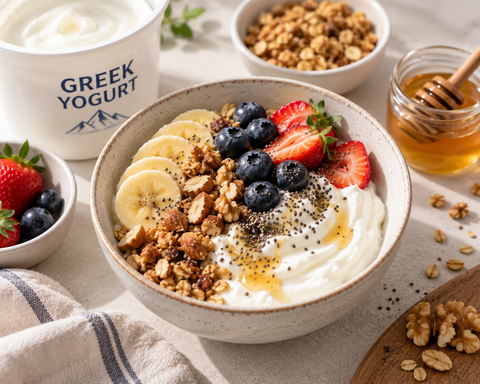
- Always pair carbohydrate with protein or fat. This blunts the spike more reliably than chasing low-GI foods. A granola bowl with Greek yogurt is a low-GI move even if the granola alone is not.
- Watch portion, not just GI. Glycemic load reminds you that amount matters as much as type.
- Do not fear whole fruit. Its fibre and water keep the real blood-sugar effect modest.
Low-GI foods worth knowing
Reliably low-GI across the international data: most whole oats, legumes (beans, lentils, chickpeas), dairy and plain yogurt, nuts, and most whole fruit. Higher-GI: white bread, white rice, instant oats, sugary cereals, potatoes. Note that many of the low-GI staples are exactly the whole foods in a sensible diet anyway.
FAQ
What is a good glycemic index?
Low is 55 or under, medium 56 to 69, high 70 or above. Lower means a slower, gentler blood sugar rise.
Does low GI mean healthy?
Not on its own. GI measures carbohydrate quality, not overall nutrition, and it ignores portion. Some high-GI foods in small amounts matter little.
What is the difference between GI and glycemic load?
GI is how fast a carbohydrate raises blood sugar; glycemic load also accounts for how much carbohydrate is in a real portion. GL is often the more practical figure.
Are oats low GI?
Whole and steel-cut oats are low to medium GI. Instant oats are higher because they are more processed.
Does pairing food change GI?
In practice, yes. Eating carbohydrate with protein, fat or fibre slows the blood sugar rise, which is why mixed meals behave better than the isolated food’s number.
General information, not medical advice. People managing diabetes should follow their own clinician’s guidance.
More from the kitchen
 GuidesGreek Yogurt: What It Is, How It Differs, and How to Make ItGreek yogurt has one defining feature, and once you know it, the whole product…
 The Best Time to Eat Oats (Morning, Pre-Workout, or Night)As with most foods, the honest headline is that when you eat oats matters…
 GuidesWhat “Eat Clean” Actually Means (And Where It Goes Wrong)“Eat clean” is one of those phrases everyone uses and nobody defines the same…