
Foods for Energy: Why You Crash at 3pm and What Actually Helps
 Image generated with AI — may not represent the actual product.
In short
Here is the part almost nobody tells you: the afternoon slump is coming whether or not you eat lunch.
The Olaben Kitchen shares recipes and food inspiration only. This is not medical or nutritional advice. If you have a health condition, allergies or specific dietary needs, please consult a qualified professional.
Here is the part almost nobody tells you: the afternoon slump is coming whether or not you eat lunch.
Timothy Monk’s review in Clinics in Sports Medicine put it plainly. The post-lunch dip “is a real phenomenon that can occur even when the individual has had no lunch and is unaware of the time of day.” Sleep researchers modelling daytime sleep pressure found the same thing, describing the early-afternoon peak as “better explained as a circasemidian phenomenon than as an aftereffect of eating lunch.” Your body runs a secondary sleep-pressure peak that tops out around 2pm. It is on the clock, not on your plate.
So food is not what causes the dip. Food is what decides how deep it goes. Monk’s review finishes the thought: the dip “is certainly exacerbated by a high-carbohydrate lunch.”
That distinction changes the whole question. You are not looking for a food that gives you energy. You are looking for a lunch that does not make a dip you were already going to have worse.
What “energy food” actually means
All food is energy. That is what a calorie is. When an article promises “energy-boosting foods,” what it can honestly mean is: foods that release glucose into your blood gradually rather than in a spike, so you get a plateau instead of a peak and a fall.
The mechanism is gastric emptying, and the research here is specific. Writing in Diabetes Care, researchers reviewing gastric emptying and blood glucose found that fat is the most potent macronutrient for slowing how fast your stomach empties. Protein does it too, with whey protein preloads producing the slowest emptying of the proteins studied. And on fibre: “increasing dietary fibre or adding guar gum slows emptying and reduces postprandial glucose… as a result of retardation of both gastric emptying and intestinal glucose absorption.”
Protein eaten before carbohydrate cuts the glucose excursion by roughly 30 to 40 percent in oral glucose tolerance testing. Same food, different order, meaningfully different curve.
So the rule is not “eat X.” It is: never send carbohydrate into your stomach alone.
The glycemic index, with the numbers
Most articles tell you to eat low-GI foods and then never tell you what counts as low. The International Tables of Glycemic Index and Glycemic Load Values, published in the American Journal of Clinical Nutrition, set the bands on a 100-point glucose scale:
|
Band |
GI value |
|
Low |
55 or under |
|
Medium |
56 to 69 |
|
High |
70 or above |
One finding from that dataset deserves more attention than it gets. The authors catalogued over 4,000 foods and found that cereals, breads and rice vary enormously, existing in high-, medium- and low-GI versions. “Whole grain” does not automatically mean low GI. A whole-grain bread can sit above 70. The label is a marketing term; the GI is a measurement.
Dairy, legumes, pasta and most fruit are reliably low-GI across the international data. That is a more useful shortlist than “eat whole grains.”

The caffeine mistake
Coffee appears on every energy-food list as a straightforward win. The timing is where it goes wrong, and the numbers are stark.
Caffeine’s mean plasma half-life in healthy adults is about 5 hours, with a range of 1.5 to 9.5 hours depending on genetics, age, medication and smoking. That means a 3pm coffee still has roughly half its caffeine working at 8pm, and a quarter of it at 1am.
The controlled trial is the one worth knowing. Drake and colleagues, publishing in the Journal of Clinical Sleep Medicine in 2013, gave 12 healthy adults 400mg of caffeine at 0, 3 or 6 hours before bed, double-blind and placebo-controlled. Even at six hours before bedtime, caffeine cut objectively measured total sleep time by more than an hour. Sleep latency rose about 24 minutes.
Then the detail that matters most: “subjective reports suggest that participants were unaware of this sleep disturbance.” They lost an hour of sleep and could not feel it. The authors recommend stopping caffeine a minimum of six hours before bed.
This is how the loop builds. You crash at 3pm, you drink coffee, you sleep worse without noticing, you wake up with more sleep debt, and tomorrow’s crash is deeper. The coffee is not fixing the dip. It is financing it.
Dehydration is the cause people skip
You do not need to be thirsty to be measurably impaired.
Two controlled studies from the same research group settled this. In the British Journal of Nutrition, Ganio and colleagues dehydrated 26 men to a mean body-mass loss of 1.59 percent, with no heat stress. The conclusion: “mild dehydration without hyperthermia in men induced adverse changes in vigilance and working memory, and increased tension/anxiety and fatigue.” Fatigue at rest reached significance at p=0.040.
The companion study in the Journal of Nutrition took 25 women to a 1.36 percent body-mass loss and found degraded mood, higher perceived task difficulty, lower concentration and headache.
Roughly 1.5 percent body-mass water loss is below the point where most people register thirst. If your 3pm feels foggy rather than sleepy, water is the cheapest thing to rule out first.
The Academy of Nutrition and Dietetics puts daily total water intake at about 15.5 cups (3.7 litres) for men and 11.5 cups (2.7 litres) for women, from all food and drink combined.

When it is not the dip at all
If your fatigue is constant rather than clustered around 2pm, stop reading nutrition articles and get bloodwork.
Anemia is more common than most people assume. The National Center for Health Statistics data brief covering August 2021 to August 2023 put overall US prevalence at 9.3 percent for ages 2 and up. The split matters: 13.0 percent of females versus 5.5 percent of males. Among females aged 12 to 19 it reaches 17.4 percent, and 14.0 percent for ages 20 to 59.
MedlinePlus describes it directly: “Anemia can make you feel tired, cold, dizzy, and irritable. You may be short of breath or have a headache.”
Iron deficiency without full anemia is more common still. Persistent fatigue, breathlessness on stairs, cold hands, unusual irritability: that is a blood test, not a breakfast problem. Thyroid disease, diabetes and sleep apnea all present the same way.
A lunch that does not dig the hole deeper
Build it in this order:
- Protein first, and enough of it. Eggs, fish, chicken, tofu, Greek yogurt, lentils. Eat it before the carbohydrate on the plate.
- Fibre alongside. Vegetables, legumes, or the fibre already in whole foods. Our guide to fibre covers the soluble and insoluble split.
- Carbohydrate, but portioned and not naked. Rice and bread are not the enemy. Rice and bread alone, in a large portion, at noon, are the problem.
- Fat for the brakes. Nuts, olive oil, avocado. Fat is the strongest gastric-emptying brake you have.
- Water before the coffee.
For breakfast, the same logic applies from the start of the day. The balanced breakfast formula is protein plus fibre plus a healthy fat plus fruit, and it holds up because it is really a gastric-emptying formula wearing a friendlier name.
Harvard Health’s cereal spec is a useful shelf test: at least 5g fibre, under 300mg sodium, under 5g sugar per serving. Most granola on the shelf fails that third one, which is why we wrote what is actually in good granola and how to read a nutrition label.

What to eat at 3pm
If the dip lands and you need something, the same rule applies at snack scale. Aim for protein and fibre together, not sugar alone.
- A small handful of nuts, about 28g. Our Premium Nuts Mix or salt-roasted cashews.
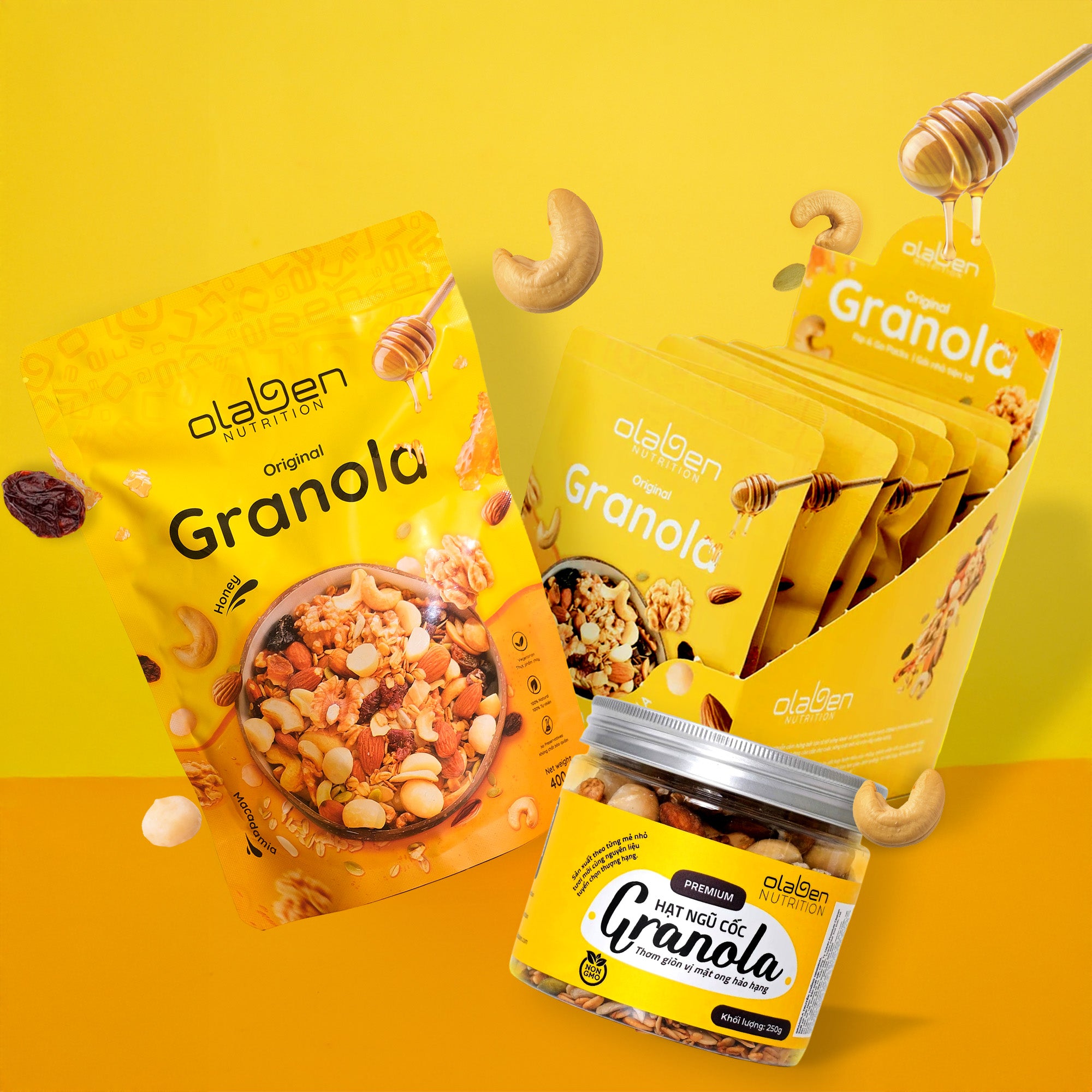
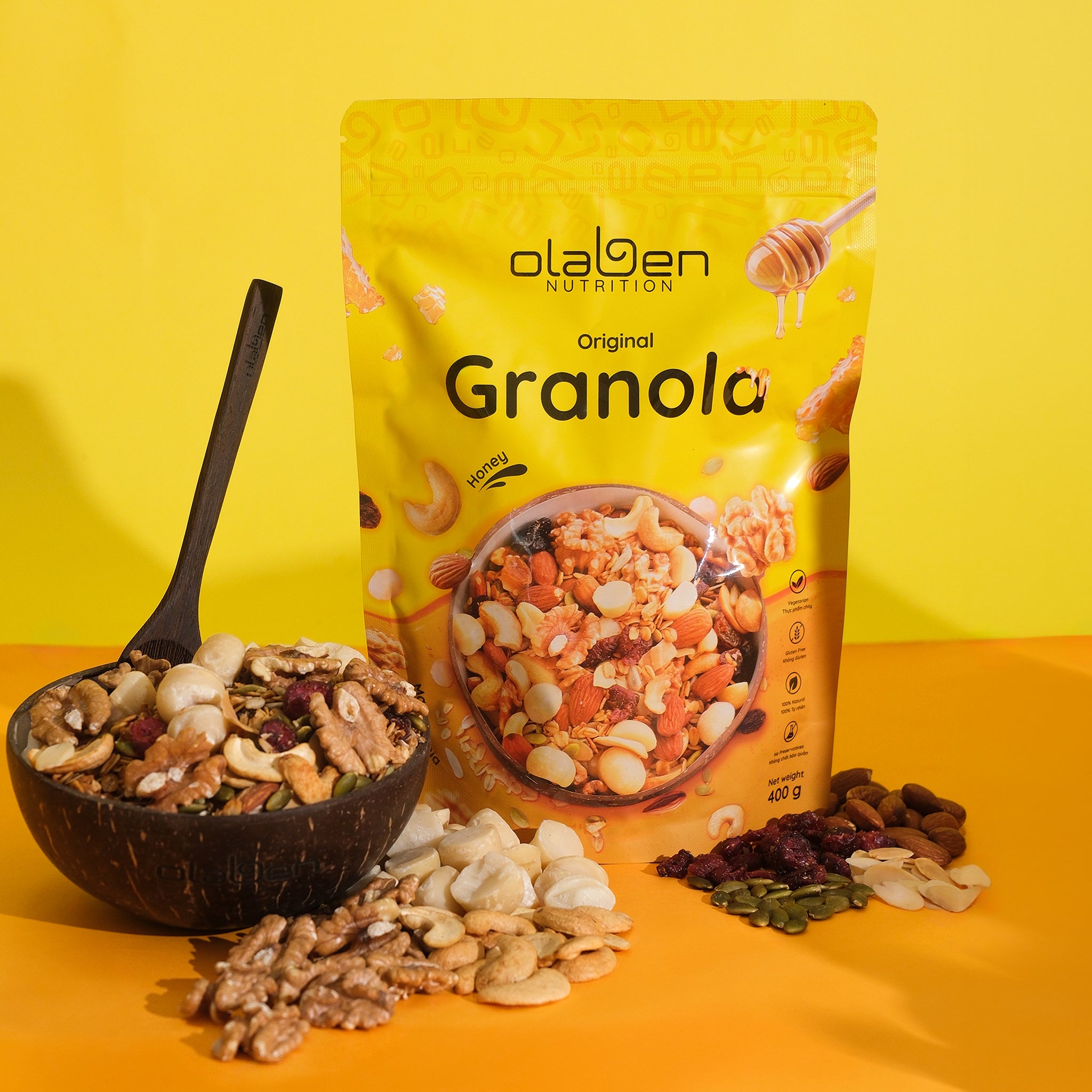
- Granola over yogurt rather than granola alone, so the protein arrives with the carbohydrate. Premium Granola Original.
- A seaweed brown rice bar if you want something savoury.
- Something caffeine-free if it is past your cutoff. Our tea range is all tisane, so there is no caffeine in it at all.
A 15 to 20 minute walk outdoors does more for the 2pm dip than most snacks, and it costs nothing.
FAQ
Is it normal to feel sleepy after eating?
Yes. It has a name, postprandial somnolence, and a body-clock component that shows up even without lunch. A large, carbohydrate-heavy meal makes it worse rather than causes it.
What foods give you instant energy?
Anything high-GI: fruit juice, white bread, sweets. They work for about 30 minutes and then hand you a steeper fall. Useful mid-workout, counterproductive at your desk.
Should I nap?
A 15 to 20 minute nap works with the dip rather than against it. Longer naps risk waking out of deep sleep, which feels worse than the dip did.
Is feeling sleepy after eating a sign of diabetes?
It can be, particularly with thirst, frequent urination or unexplained weight loss. Persistent post-meal fatigue is worth raising with a doctor rather than diagnosing from an article.
How much protein should lunch have?
Enough to matter. For most adults that is a palm-sized portion of a protein food. The order it arrives in appears to matter as much as the amount.
This article is general information, not medical advice. If fatigue is persistent, see a doctor.
More from the kitchen
 Plant-Based Eating: Protein and the Nutrients to WatchYou can get enough protein on a plant-based diet, and the complete-protein rule is…
 What to Eat with Diarrhea: Gentle Foods and What to AvoidHydration matters more than any food, then gentle, low-fibre foods while you recover. What…
 Green Tea: Real Benefits, Caffeine, and the Weight-Loss TruthGreen tea is a genuinely good drink with one heavily oversold claim. The antioxidants,…